Day 6:
We packed our belongings and started the day with breakfast and a trip to the spot where Jesus helped the disciples catch 153 fish (John 21) beside the spot where he fed the 5,000. This is after Jesus has been crucified and risen from the dead to appear to the disciples. The area is called Tabgha "seven springs" and is a spot where there were 7 healing springs...3 now exist.
We went from there up the hill to Capharnaum (Capernaum-Jesus' hometown after he left Nazareth). It's also home to disciples Peter, Andrew, James and John as well as Matthew. We saw the house of Peter, an octagonal church, which now has a church built over it. This would have been the place Jesus used as his "headquarters" in Capernaum. It's also the place that Jesus healed Peter's mother-in-law in Matthew 8:14-15. This would have been the spot from Luke 5:17-26 and Mark 2:1-12 where the paralyzed man was healed.
A Roman centurion built the synagogue in which Jesus often taught. That same centurion is the one in which Jesus healed his servant. (Matthew 8:5-13) The town synagogue is still partially standing. It's dated to the 4th and 5th century from coins found on the floor, but underneath, a 1st century structure was discovered. We toured that and saw the first "tic-tac-toe" game.
From there, we drove through Cana where Jesus performed his first miracle (turning water into wine). My notes say that the wedding would have been on a Tuesday because it was the most Holy Day??
A Church over the spot where the miracle happened and the town well where Jesus would have gotten the water.
We drove past Nazareth, the childhood home of Jesus, to the Mount of Precipice. This is believed to be the spot where the people of Nazareth wanted to throw Jesus (who was about 30 years old at the time) off the cliff for claiming to be the Messiah (Luke 4:14-30). It was a great place to see the Jezreel Valley, Mt. Tabor, Megiddo (Valley of Armageddon), etc. A plaque at the top says Jesus jumped from this mountain when fleeting his pursuers. The first base jump perhaps? HAHA!!
Next we stopped in Megiddo, a fortress city of King Solomon, and toured. This was incredible and confusing! Armageddon has at least 20 layers of archaeology on top of each other. It dates back to the stone age. It was really hard to follow along, especially since I don't know history in that area as well. We saw a few of the city gates still standing and then climbed down to see their water system, way down below the city. It is said this will be the place for the rapture of the church and the great tribulation, but there is some disagreement on this and I haven't done an in-depth study of Revelation yet, so I can't tell you for sure.
We stopped for lunch at Tamer Halabi Restaurant. This restaurant was owned by a Druze Family. The Druze have broken away from the Muslim faith and they live in a community together. They were so nice! One of the ladies in our group speaks Arabic and the family talked to her for the longest time and give her their falafel recipe and a falafel maker. They were so honored that we stopped to eat with them!
From there we visited Mt. Carmel for incredible views reaching from the Mediterranean Sea to the Jordanian mountains. 1 Kings 18 explains how Elijah went to Mount Carmel and brought down the prophets of Baal, 450 pagan prophets. There's now a Carmelite Monastery in this location.
Finally we wound our way into the beautiful city of Haifa, where our hotel overlooked the Baha'i Gardens. We enjoyed a walk around the neighborhood and dinner.
Kevin went out for drinks with our guide and I took a bubble bath and went to bed.
Day 7:
Unfortunately we had to leave Haifa after only being there for a few hours, so on the morning of day 7 we packed our bags and loaded on the bus with a first stop at Caesarea by the Sea (Caesarea Maritima/Caesarea Palestinae). This is the spot where Peter proclaimed the good news to the Roman centurion, Cornelius (Acts 10). This is another area Herod the Great built and where he had a palace. It later became a capital of Roman Judea. The ancient ruins include an amphitheater, a hippodrome (horse racing/chariot arena) and Herod's palace. There is an inscription on a building found here dedicating it to Pontius Pilate (who presided over the trial of Jesus and sent him to be crucified). An amazing find to prove Pontius Pilate was a real person. This is also supposed to be the location of Herod's tomb. On the grounds, there is a castle and Crusader church. We walked through the church on our way out.
We drove down the road to the Roman aqueducts Herod had built to transport fresh water into his seaside palace, ten miles from the base of Mt. Carmel.
We had lunch at a burger bar before heading to through the Judean Hills towards Bethlehem.
Bethlehem is currently a Palestinian city, so our Jewish guide needed to get off the bus before we entered the gates with armed guards to see Bethlehem. For the few hours we were there, we had a Palestinian guide get on the bus with us. Not only the birthplace of Jesus, Bethlehem is where King David was born, the burial place of Rachel and the home of Ruth and Boaz.
Our first stop in Bethlehem was a shepherd's field that is taken care of by the YMCA. In this field there are shepherd's caves and we were able to go in one to discuss the life of a shepherd and what those in Luke 2 might have experienced before Christ's birth.
Next was a stop in the Church of the Nativity which is the spot of the "manger" where Jesus was said to have been born. The church has a very small entrance door that is said to have two purposes: #1 to prevent people storming the church on horseback (This is the oldest church in Israel) and #2 so Christians would have to bow to Muslims (during their rule in Bethlehem). There was scaffolding up for some reconstruction and the church was very crowded, so only a select few got to go down to the spot in the basement where Jesus was born. Kevin was one of the ones chosen to go.
Once again, there are many things hung and left as gifts to the baby Jesus in this spot and it's a bit claustrophobic. There's a fourteen-point star that signifies the spot Jesus was born.
The rest of us walked from the church we were in into another church (there are about 3 or 4 on the site) to see a 1700 year old mosaic floor and admire a statue of Jerome who is the man that translated the Hebrew Old Testament into Latin, bringing the Word of God to more people.
Our last stop in Bethlehem was at one of the few Christian owned stores that sells olivewood products. Here Kevin and I got gifts for our family and friends and a nativity set.
Then it was off to Jerusalem to settle in for the night. It was Shabbat, so our hotel elevators weren't working (on Shabbat, the Jewish people can do no work from a few minutes before sunset on Friday evening until the appearance of three stars in the sky on Saturday night, so the elevators are put on a rotation where the doors open and close on their own so no one has to "work" by pressing the buttons). The dinning room was also VERY crowded because no one can work by cooking for themselves, so many families dine out. The restaurants are able to follow Shabbat because they cook all of the food before Shabbat starts or have food that doesn't have to be cooked/prepared. This was a very interesting experience for us.
Day 8:
Our next morning started with breakfast before heading out to the Mount of Olives. This is the highest point east of the holy city on the other side of the Kidron Valley and gives great perspective and good views of the Dome of the Rock. I didn't realize that the entire side of the Mount of Olives is a series of cemeteries. Jews have been buried there for 3,000 years and the area holds about 150,000 graves. This is a desirable spot for burial because of Zechariah 14, which says when Jesus comes again, he will come to the Mount of Olives and the resurrection of the dead will begin there. In Acts 1:9-12 we also learn that Jesus ascended to heaven here.
We walked from the top of the Mount of Olives down towards Jerusalem following the path Jesus would have taken on Palm Sunday when he triumphantly entered the city. (Matthew 21: 1-17, Mark 11:1-11, Luke 19:29-40, John 12:12-19)
Our next stop was the Church of All Nations (Basilica of the Agony) beside the Garden of Gethsemane where Jesus prayed the night he was betrayed.
We spent some time here before moving over to the Garden to have a devotional in the midst of the thousand-year-old olive trees and have some quiet time for reflection. (Matthew 26:36-56)
From here we got back on the bus so we could enter the old city through St. Stephen's gate (Lion Gate). This is where we started our walk on the "Way of the Cross"-Via Dolorosa.
Our first stop was a Byzantine church believed to be built on the spot of the Virgin Mary's birth home. Her mother was Anna, hence the name St. Anne's Church. This Crusader church is designed for Gregorian chants, so we sang on our visit. Only religious songs are allowed.
Behind this are the Pools of Bethesda where people would go for healing and where Jesus healed the lame man (John 5:1-15), on the Sabbath.
We stopped at The Church of Condemnation and Flagellation where it's believed that Pontius Pilate judged Jesus and from where he was forced to pick up this cross and walk through the city. We went to the Sisters of Zion Convent beside this location to see the pavement where soldiers cast lots for Jesus' clothes.
We saw the Ecce Homo Arch and then continued on the Via Dolorosa into the Muslim Quarter for lunch at Panoramic Golden City, where we had a rooftop lunch with great views of the holy city.
We had some free time for shopping and we were supposed to continue on to the Church of the Holy Sepulcher where it's believed Jesus was circumcised and presented in the temple as a baby and where some believe he was crucified. Because it was the day before Palm Sunday, the crowds were too great and we weren't able to stop in.
So, we got on the bus and headed for the Israel Museum where we got to see a huge scale model of Jerusalem, which helped to make sense of what we had seen and imagine it as it once was.
Then we went in the Shrine of the Book where some of the Dead Sea Scrolls are displayed. The most famous are two copies of Isaiah that were written only six centuries after Isaiah first wrote his prophesies of Jesus. We were able to tour inside the Israel Museum for awhile. A highlight here was seeing Robert Indiana's "Love" sculpture in Hebrew.
Day 9:
We woke up and went to breakfast and between that and loading on the bus, I got sick for the first time. I had started feeling congested, so I gargled with meleluca and threw up in the sink. Yuck! And thus begins my decline.
Our first stop was the Western Wall (Wailing Wall). When the temple was destroyed in 70 AD, this was the only thing that remained standing. This is the closest spot you can get to the Holy of Holies (on the temple mount), so day and night you can find Jewish men and women praying at the wall. They write their prayers on pieces of paper and slide them into the cracks in the wall with the belief that those prayers will be closest to God, so they'll be answered. Men have to have their head covered, so there are yamakas provided for them. There is separation of men and women at the wall. This was a somber place and very sad for me to think that these people are desperate for their prayers to be answered so much so that they camp out at the wall.
We left here and went underground to walk on the original roadway beside the Western Wall. This was just discovered in 1967 by engineers laying water pipes. We got to see the HUGE rocks that were used to build the temple mount. Crazy incredible to know we were walking on the same "road" Jesus and his followers could have walked years ago.
Our next stop was the Jerusalem Archaeological Park and the Davidson Center. We watched a video of what the area would have looked like back in the day and learned how people entered the temple mount and participated in the ritual baths and made their sacrifices. We went out and viewed what's left of the Robinson's Arch (a huge arch that crossed the street we were on and would have been an entrance into the temple mount.) And then we saw the steps that rise from the south to the temple. We climbed the steps, like Jewish pilgrims would have done to enter the original doors of the temple. From here we could see down into the City of David and that was our next stop.
I really enjoyed the City of David. It was built before everything on the temple mount, so it was the original king's palace. It's very easy to see how David could have looked out and seen Bathsheba bathing on a rooftop. The slope of the hill it's on would have made that very possible. Just one more thing I couldn't picture until I was in Israel and now I'll always read that Bible story in a totally different way.
There are several water tunnels in this site...one which was built by King Hezekiah and still carries water. We walked down to see the water tunnels and then half of our group walked through (Kevin was in this group), while the rest of us stayed in the dry tunnel.
They came out in the Pool of Shiloah (Siloam). This is where Jesus healed the blind man in John 9:11.
This was incredible because how did people have the resources that long ago to build a tunnel? An inscription was found in the tunnel and it says:
No one knows what the word zidda means, so we don't know how they did it, but it was pretty incredible!
From here we loaded up and went over to Yad Vashem, the World Holocaust Rememberance Center. We had lunch here. I wasn't feeling well and apparently others found their chicken was raw, so I could have gotten even more sick here. We went to the Children's building where the memorial is one candle and mirrors reflecting the light to look like stars in the sky, representing the 1.5 million Jewish children that died. There is a recording that reads off all the children's names. This was very moving! We walked around to see some of the memorials and ended in the garden of trees. From here we had the opportunity to stay or go back to the hotel for free time. I would have liked to stay, but I was feeling worse and I was already very emotional from what we had seen at the Holocaust Center, so we went back.
Kevin and I walked from the hotel to an outdoor mall just outside the Old City for him to get a coffee and window shop. We walked into the old city, entering from the Jaffa Gate and ran into some of our group.
We walked back to the hotel and stopped at the large windmill just across from our hotel: Ha-Takhana.
As soon as we got in the room, I crashed and the sickness came on. Fever, chills, I was sweating, but freezing to death. I slept. We missed dinner. We ordered room service because I really wanted some ice, my mouth was so hot and it's possible the ice contributed to my sickness too. I threw up again. I had a fitful sleep, but my fever broke and I felt much better in the morning.
Day 10:
It was time to pack up our bags for good...store all of our souvenirs and get ready to depart. I still didn't want to eat anything, but some of the ladies got me a ginger ale, which was really nice!
We started the morning at the Garden Tomb. Again, some believe Calvary/Golgotha is where the Church of the Holy Sepulcher is, but we went to another location, a garden just outside the old city where there is a rock-face that looks like a skull. This place would have been on a Roman road with lots of traffic to make an example of the criminals on the cross. It's also a place where they found tombs. One is much nicer than the others and is believed to be the one that Joseph of Arimathea (a wealthy man who believed in Christ) gave for Jesus' burial tomb. The Garden Tomb doesn't claim to be THE SPOT and is run by volunteers. Something about that and the peacefulness of the garden made me think it actually was the place. Our guide there talked about the skull in the rock and his faith journey. We were overlooking a bus station and the people there were doing everything in their power to be disruptive, which was kind of cool too because to want to disrupt me and my God means they recognize him!
We walked down and were able to go into the tomb to look around. I was making numerous bathroom breaks at this point, so I missed the part about the stone and it being rolled away, but there are channels in the rocks in front of the tombs where the stone would have been. We had communion here and various group members had the opportunity to share about what the trip meant to them. This was very powerful and meaningful!
We left here and went back into the old city, but this time in the Jewish quarter. We walked The Cardo, a stone-paved street between the Damascus Gate and the Zion Gate, dating to the Roman & Byzantine eras. We got some of the Jerusalem Bagels with za-atar for dipping and learned more about this area. The Jewish quarter looks fairly new compared to the other areas, probably because the 2,000 Jews that were still in the city in 1948 were forced to leave and the quarter was destroyed. After the Six-Day War in 1967 it was recaptured and the rebuilding started.
We had some free time here, so Kevin and I got a Gatorade for my stomach and he had a little snack while we watched groups of people celebrating Jewish boys on their barmitzvah. Some had bands and balloons and parades down the street. It was fun!
Next was lunch at The Quarter Cafe. The people here were so nice! We had a set buffet meal to choose from and I was going to get plain noodles, but when the staff heard I wasn't feeling well, they made me plain rice and fixed me up with some bland foods and a hot tea to settle my stomach. So sweet!
It was time to say goodbye to Jerusalem and make the drive back to Tel Aviv, but we had one more stop. On the way, we stopped to view the Valley of Elah where David slayed Goliath. In past trips Pastor Mike has talked about collecting a stone from in the valley, which we didn't have the opportunity to do because we were on the hill looking down, but it was still awesome to be there.
Our final stop was a goodbye dinner in Tel Aviv at Derby Bar. I had plain noodles, but everyone's seafood and fish and the cold salads looked great. The restaurant was on the water and we caught the sunset just as we were arriving.
And then it was back to the airport and the long flight home. I hate I got the bacterial infection in my gut because it was really hard to concentrate those last few days and to catch all of the details at every stop with running back and forth to the bathroom. However, this really was a trip of a lifetime.
If we ever go back, I do have a few must-sees on my list:
I must see Jericho.
I would spend more time in Tel Aviv and Haifa.
I must see the Upper Room (there are two locations, obviously).
And I'd like to see the Church of the Holy Sepulcher.
I'd enjoy going into Nazareth and learning anything I could there about the town as it relates to Jesus.
I'd like to go up on the temple mount and see the Dome of the Rock and the Mosque.
It's in Jordan, but I'd really like to see Petra.
If Israel has ever been on your list, go! And Happy Easter! He's Risen! I know because the tomb was empty!
Kevin and I traveled to Israel last March with other people from Hope Community Church in Raleigh, some from Florida and others from Charlotte. It was a Holy Land Tour. We spent 10 days seeing all of the places of the Bible. It was a dream trip! When we were dating in 2010, we signed up to go on a Holy Land Cruise...but the political fighting started in Egypt and Pastor Mike backed out of leading the trip and we thought if he didn't want to go, maybe it wasn't safe for us to go either, so we cancelled. When this opportunity came back around, we jumped on it! It was a better option because it wasn't a cruise and although Egypt wasn't included, having more time in Israel was a perk. It was really expensive and a trip like we've never done before (as part of a tour group), so we weren't quite sure what we were getting into. What we did know is that being with a group was safer than us going on our own. We knew we'd have three pastors with biblical knowledge to share along the way and we knew we'd have a guide. We also knew we'd have a Jew and a Palestinian in our midst, so if any conflict arose, we'd have some sort of ally.
What we didn't know is how we'd mesh with the group. I plan all of our trips and each day is moderately planned to maximize our time abroad. I always book in loose plans...like if we can't go to this church on Tuesday morning, we can see it Wednesday afternoon. But then what we planned for Wednesday afternoon, we can also do Wednesday morning or Thursday morning...etc. There is a back-up in case what we want to do isn't possible, to make sure we hit the highlights. How would that work as a huge group? And I was worried about meals. What if I'm starving and we don't stop to eat? Kevin and I, while we enjoy people, we also like to explore on our own and enjoy the flexibility that comes with just the two of us. We just didn't know how a whole bus-load of people would dictate our days.
The good news is the group-tour thing worked for us. How I generally summarize our trip to Israel is there was SOOOOO much to see, that if we had toured on our own, we probably would have missed a large part of what we got to see. And then the trip wouldn't have been worth it. The down-side was that after touring a place, we'd be told we had about 10 minutes for pictures/bathroom break, etc, before we had to be back on the bus. So, we didn't have much time to do our own exploring. Another plus was all of our meals were generally prepared when we arrived, so we'd sit down and eat (or enjoy a buffet at the hotel). There wasn't much waiting around for that. And with a guide, anytime we entered a place where we would have had to pay or get tickets, we just walked straight in instead of waiting in line. Many things were arranged for us behind the scenes to make our time more efficient. And that was awesome!
If you get the chance to go to Israel, GO! Especially if you have a relationship with Jesus. This trip really made the Bible come to life for us and I can't explain how awesome it is to have a real place in your mind when you read from the Bible or hear about it in church. It's like seeing in 3D or vivid color.
I would love to go back to visit Israel again. Something about it just lands in your heart and you feel the need to visit again. Our tour guide does smaller tours where he hikes from the Mediterranean to the Sea of Galilee. You camp out at night and then start your hike the next morning. Kevin was REALLY interested in that! And, I know that if I ever go back, I'll stay in more modest accommodations to save money. We enjoyed our trip so much, but I think a bulk of the money we paid was for these exceptionally nice hotels. I'm sure we could stay at a kibbutz for much cheaper.
So what did we see?
Day 1:
Kevin and I opted to fly in a day earlier than the majority of our group so we could see Tel Aviv and hopefully feel rested. I think that was a great option! The morning we picked up the rest of our group, they had flown all night and were snoozing on the bus in no-time.
I really wanted to experience Tel Aviv (the new old city) and walk over to Jaffa (Yafo, Japho or Joppa) for dinner. Jaffa is the oldest part of Tel Aviv and a port city made famous in the Bible by Jonah (the port city he left on his way to Tarshish), Solomon (where the cedars of Lebanon came into port for the building of his temple) and Saint Peter (Acts 10:9-11:18 where Peter has the vision of clean and unclean animals and realizes he has to share Christ with the gentiles too). We didn't know we'd get to see Jaffa with our group the next day, so we made the most of it the night before.
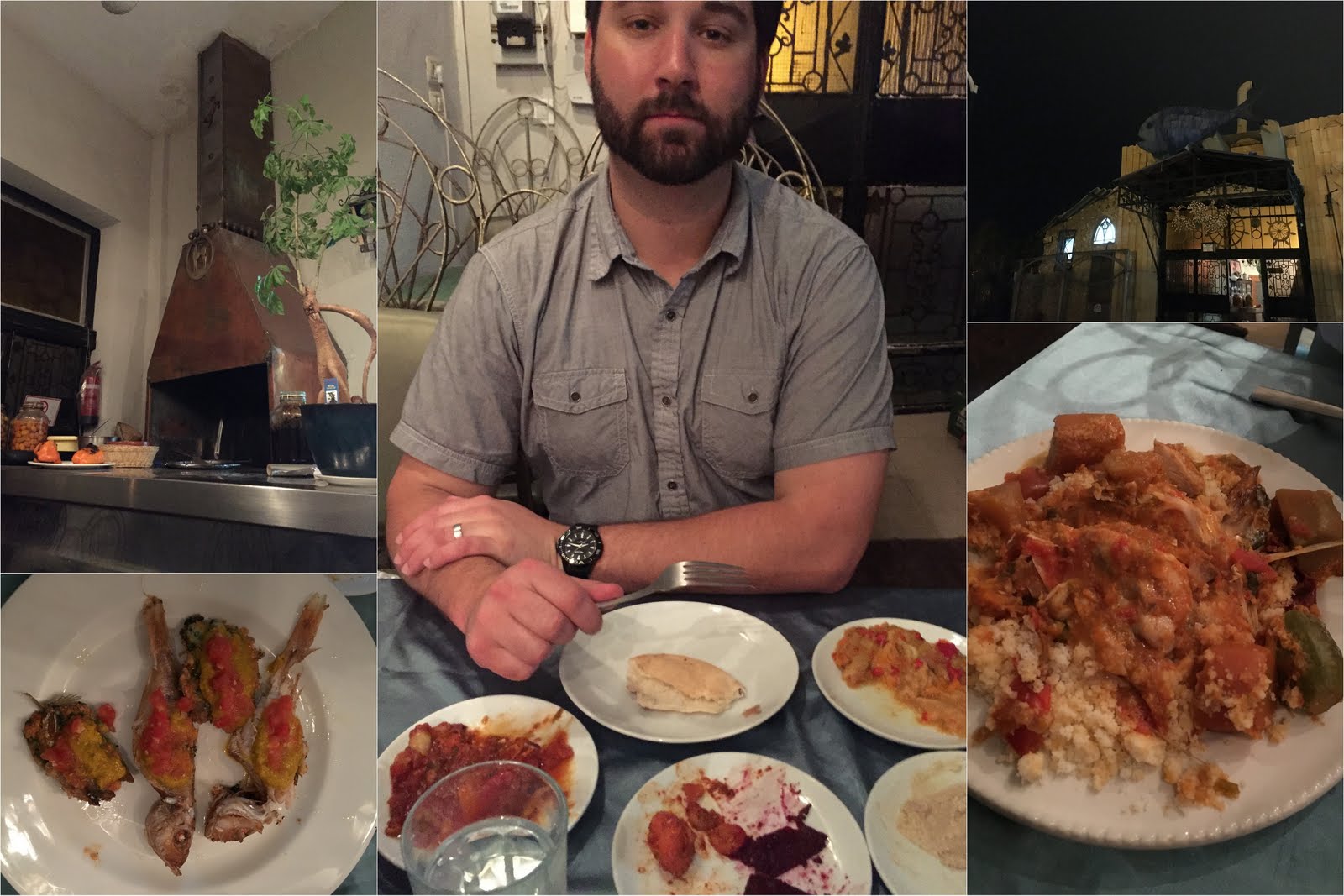
We settled into our hotel and then walked on the Tel Aviv-Jaffa Promenade along the Mediterranean over to Jaffa for dinner at Margaret Tayar's restaurant.
I had read about Margaret Tayar's on Frommers and was impressed that Jaffa's fishermen bring her the first catch of the day before distributing to the other fine dining restaurants in town. The restaurant seats maybe 8 people, and Margaret herself is in the kitchen cooking every meal. Of course, she dictated a bit of what our meal would be and made us eat liquor figs as our dessert, but it was such an experience.
We finished off our first day with a quiet walk around old Jaffa before returning to our hotel to crash.
Day 2:
We were up early to walk down to Banana beach to stick our feet in the Mediterranean sea.
Then it was packing up our room and enjoying our breakfast so we could hop on the bus and go back to the airport to gather the rest of our group.
Wouldn't you know, as soon as we had the whole crew, we headed straight for Jaffa. This was our first indication of how much we were going to learn each day and how broad the history was going to span! We started up at the top of Tel (which means a hill or mound) Jaffa at the Statue of Faith sculpture (which we had seen the previous night). The carvings on this include the Binding of Isaac, the Conquest of Jericho and Jacob's Ladder.
From there we walked down to an area below the tel to an archaeological site with an Egyptian gate "Ramses Gate" showing how Pharaoh Thutmose III conquered the city in 15th century BCE (we use BC, which I always thought was "before Christ"...they use BCE, which is "Before the Common Era").
We walked through the small streets of Jaffa to see the sculpture of a suspended orange tree, a tribute to Jaffa since they're known for the Jaffa Orange, and made a stop to see Simon the Tanner's house.
This is the house Peter was staying in when he had his vision that lead to the gospel being shared with all of us (Acts 10:5-6). We also got a peek at the Jaffa lighthouse, which is fun for lighthouse lovers!
Next was lunch at Abrage in Jaffa and then it was on the bus for the drive to the Dead Sea.
On the drive we learned about the geography of Israel and very clearly saw the change from lush land to desert. We stopped for a bathroom break and had an encounter with a random camel.
Most of our group was snoozing by the time we reached our hotel, Herod's Dead Sea Hotel. After checking in, we took a glorious swim float in the Dead Sea (Earth's lowest elevation on land) before our buffet dinner.
Day 3:
After a buffet breakfast we loaded up for a full day of history/exploration/biblical studies. First stop was En Gedi (Ein Gedi)- which literally means "the spring of the kid (young goat)", where David hid in the caves taking refuge as he fled from Saul (1 Samuel 23:29), and one of the few lush areas around the Dead Sea region.
Remarkably fresh water flows from this area into the Dead Sea. An oasis in the desert. The story is told that Cleopatra had Mark Antony acquire this area from his good friend King Herod. At the time it was said to be filled with balsam plants. Cleopatra used the balsam plant to make perfume that she put on everything around her and it was said to be the best smelling perfume ever. No one knows exactly what the balm from the balsam plant is, and this plant is most likely no longer surviving. It's mentioned about 40 times in the Bible (my guess is it's the most precious essential oil ever). There are some accounted descriptions from Pliny the Elder, but we just don't know now. Everything in En Gedi was destroyed by fire at one point, including any hints as to what the balsam plant is, how to make the perfume, etc. At En Gedi, we hiked through tunnels and by waterfalls. We encountered some animals and Pastor Mike did a devotional on David.
Ein Gedi is also the place where David cut off the corner of Saul's robe instead of taking his life (1 Samuel 24) and the spot where David wrote many of the Psalms.
After En Gedi, we made our way to Kfar Hanokdim-a Bedouin village where our leaders faked our bus breaking down and lead us off the bus to ride camels into the village. What an experience!
We sat in a tent and learned a little about the village and their coffee and tea ceremony. We were treated to a delicious lunch here. Bedouins are like Gypsies. They live in tent villages and move frequently throughout their lives. Anyone is welcome in a village and a complete stranger could stay 3 days without being asked his whereabouts. In those 3 days, he's protected by the community and treated like a guest. When guests arrive, they are ushered in, a rug is spread out for them and they are served sweet (hot) tea in small glasses. As that's happening, someone in the group is preparing a cardamom-spiced Arabic coffee. The first cup is poured and tasted by the host. The second is tasted by the guest and the third is to be drunk by the guest. There is some process with the coffee that also makes it known you are no longer welcome in the community and need to be on your way again (during or after those three days).
Next we moved on to Tel Arad National Park, the ancient city of Arad with it's fortress. Parts of this site date back 5,000 years, which was really cool. It was so hard to keep up with history and know what time period we were talking about at each stop.
The "House of Yahweh", the only one discovered in the land of Israel, was found here. This is where the holy of holies would have been- "God in a box", the ark of the covenant. Amazing. This is also the region where the Israelites would have wandered in the desert for 40 years.
We ended the day with more time in the Dead Sea, a couples massage, dinner and bed!
Day 4:
We packed up our things, had breakfast and went down to take the bus to our first stop: Masada. Unfortunately, it was a cloudy day, so we couldn't see clearly from the top...such a bummer! Masada is where King Herod built a fantastic 3 tier palace on the side of a mountain (because he was Herod and could do that sort of crazy thing). We took a cable car up to the top to explore.
After Herod's death, Masada was turned into a Roman garrison. Zealots captured Masada from the garrison and Jewish refugees escaped to the fortress to flee Roman rule. They lived there until 72 AD when the Roman army surrounded them and having no where to go, the Jews decided on a mass murder-suicide pact. Thousands of Jews took their lives instead of being taken by the Romans. You can still see an area where they drew lots to decide who would kill the others. Very significant in Jewish history as over 900 people lost their lives. Masada is also thought to be one of the places David took refuge from Saul and may have inspired him to refer to God as his fortress and his rock of refuge. (2 Samuel 22)
After Masada, we went to Qumran where the Dead Sea Scrolls were discovered in the Qumran caves by a shepherd boy. Qumran was an ancient settlement where scribes lived with each other in a community and waited for the Messiah as they copied important texts.
They had strict rules to live there and had special ritual baths, quiet time and the important jobs of copying scripts. The Dead Sea Scrolls are the oldest copy of the Old Testament that we have (dating to the 1st century). Fragments were found of all the Old Testament books here except for the book of Esther. The Dead Sea Scrolls rank as one of the most prominent archaeological events of the twentieth century. It was a pretty incredible stop and we had lunch here!
Next it was off to the North, towards the Sea of Galilee to Beit She'an (Beth Shean, Beth Shan), an ancient Roman city. This was a town that people traveling from Jerusalem to Damascus would have passed through. We explored the bath house, the forum and the amphitheater.
In the Bible, when King Saul and his sons were killed in battle, their bodies were carried to Beit She'an where they were hung on the walls like trophies. (I Samuel 31) The major ruins left are Roman and Byzantine and were damaged in an earthquake in 749AD.
From there, we drove into the area around the Sea of Galilee and made a stop at The Place of Stories, the home of Gary and Cindy Bayer for a beautiful view of the sea, some snacks and some fellowship. At the time, Gary was battling cancer and unfortunately he passed away on January 6.
I'll always remember the gorgeous double rainbow we experienced from the roof of their house.
Finally, it was time to check into our kibbutz on the Northwest shore of the Sea of Galilee, have dinner and crash.
Day 5:
After breakfast, we traveled up to the northernmost tip of Israel, almost on the Lebanon/Syria border to visit Tel Dan. After a bit of a nature walk, we explored the walled city with it's alters to the pagan gods of the time.
Abraham and Elijah would have been in Dan. The best part of this visit was seeing the "Abraham Gate", a Canaanite Gate of clay. This would have been the gate Abraham used when traveling to Dan to rescue Lot (Genesis 14:14). Artifacts found here are said to read "The House of David"...which would mean it's the first time David had be listed at a site dating back before 500BC. This was just remarkable!
Just up the road, we stopped at Caesarea Philippi (Banis Nature Reserve/Ein Panis/Caesarea Panis/Neronais). Known as Baal Hermon and Baal Gad in the Old Testament. This is the grotto and Greek ruins of a worship spot dedicated to the Greek God Pan. It's where Pan and his nymphs were supposed to have lived. Jesus took his disciples up from Galilee to Caesarea Philippi and said, "who do people say that I am and who do you say that I am." Meaning, do you think I'm just another god (lowercase- like Pan) or do you believe I'm the one true God? The disciples would have known about Pan and those that worshiped him and other Greek gods. Peter said, "You are the Messiah, the Son of the living God." and Jesus tells Peter that he is the rock (and they are standing on this massive rock) that He will build the church on..."and the gates of Hades will not overcome it." Caesarea Philippi is also known as the gates of Hell. (Matthew 16). It was also at Caesarea Philippi that Jesus spoke of his coming death and resurrection. This was one of the most powerful parts of the trip for me.
From there we went up to Sa'ar Fall, a beautiful waterfall.
We had a Saint Peter's fish lunch at dag al hadan and then headed back towards the Sea of Galilee.
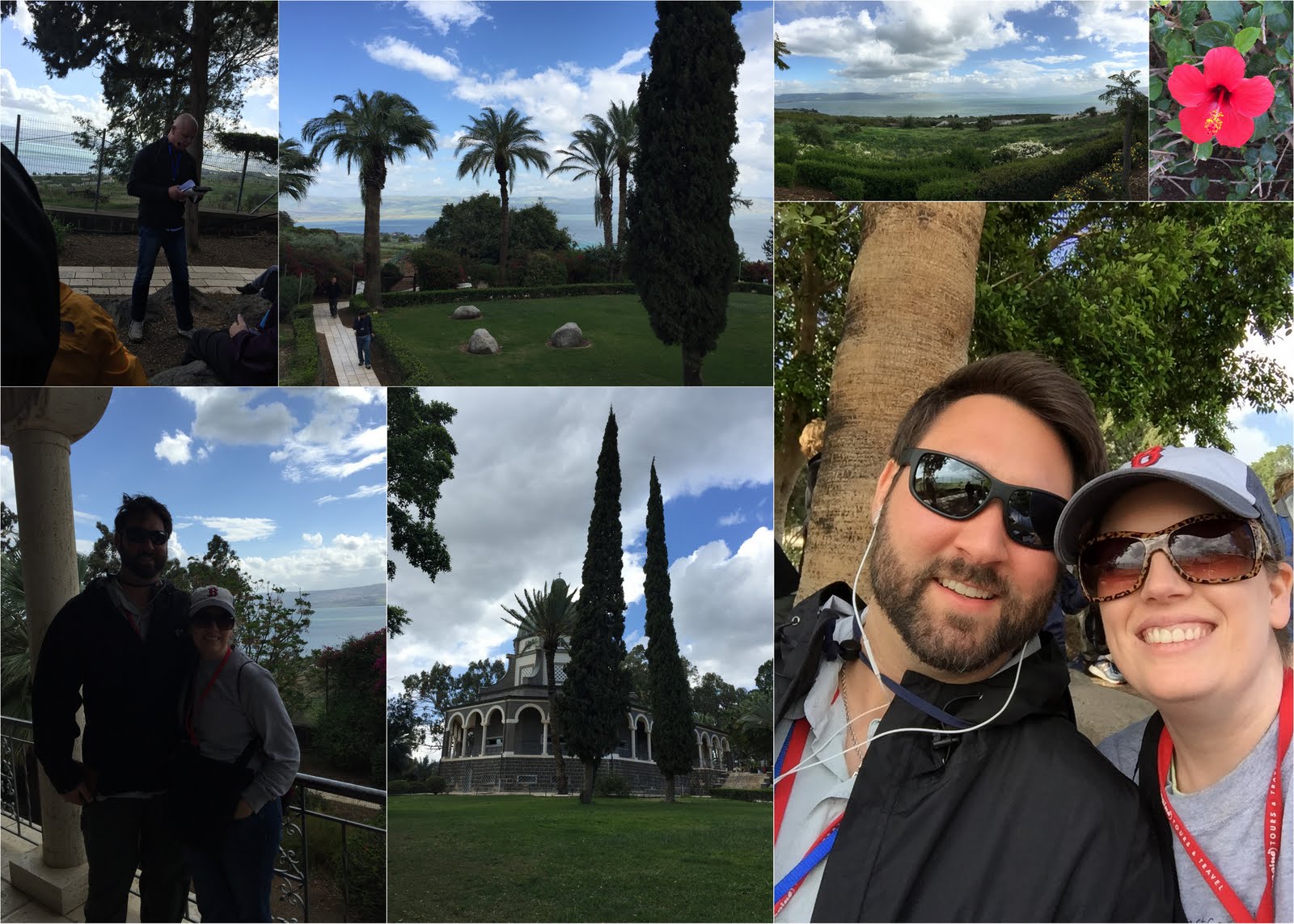
Our next stop was the spot of the Sermon on the Mount (Matthew 5). In this spot, as most, there is a church built here, the church of Mount of Beatitudes. The church is an octagon with 8 sides-each side representing one of the eight blessings of the Beatitudes.
Our guide reading the Beatitudes in Hebrew.
Next it was off to the Jordan river where Kevin, myself and three others were baptized. We knew before going to Israel that we would have this opportunity and even though Kevin and I were both baptized as babies, we wanted to be baptized together and what better place than in the Jordan river? As we were all praying before we went into the water, the weight of that decision came on me and I got splotchy and nervous. I think I was more nervous than my wedding day. I can't say I came out "changed", but it was a very memorable experience from the trip!
Our day was not yet complete. Our next stop was the Yigal Alon Museum where they have a 1st century fishing boat discovered in 1986 on the shore of the Sea of Galilee. It is much like what Jesus and the disciples would have been in on the Sea of Galilee for fishing. Interestingly, the boat was made of 12 different types of wood, very symbolic in Jewish culture.
And finally we took a boat ride on the Sea of Galilee. The captain of the boat was a singer and we sang praise and worship songs as we sailed around with the sun setting. It was gorgeous! To be on the body of water where Jesus calmed the storms and walked on water...it was just unbelievable.
After dinner, we sat around with some group members talking and then went back to our room to crash!